

Work Together
Current and recent collaborations include
〰️
Smithsonian Institution
〰️
Odyssey Works
〰️
Georgetown University
〰️
St. John’s University
〰️
Johns Hopkins University
〰️
University of Delaware
〰️
G & A
〰️
American Alliance of Museums
〰️
America for Bulgaria Foundation
〰️
Museum Next
〰️
Museum and the Computer Network
〰️
Current and recent collaborations include 〰️ Smithsonian Institution 〰️ Odyssey Works 〰️ Georgetown University 〰️ St. John’s University 〰️ Johns Hopkins University 〰️ University of Delaware 〰️ G & A 〰️ American Alliance of Museums 〰️ America for Bulgaria Foundation 〰️ Museum Next 〰️ Museum and the Computer Network 〰️
The Lab offers multiple ways to engage with futures thinking and prototyping for museums and cultural organizations. All consulting and workshops are led by Isabella Bruno, often in collaboration with our network of advisors and partners.
We use our values as a rubric, combined with periodic reflection and evaluation, to make sure projects are running smoothly and with intention. We also do our best to push against scarcity, to move at the speed of trust, not commercial pacing, and to respect our collective bodily and emotional needs, regardless workplace conventions.
The Lab also develops custom programs, collaborative research, and experimental formats. If you have an idea that doesn't fit these categories, let's talk.
Current and recent collaborations include:
Smithsonian Institution
Georgetown University
St. John’s University
Johns Hopkins University
University of Delaware
Museum and the Computer Network
Museum Next
America for Bulgaria Foundation
American Alliance of Museums
Odyssey Works
Noble
G & A
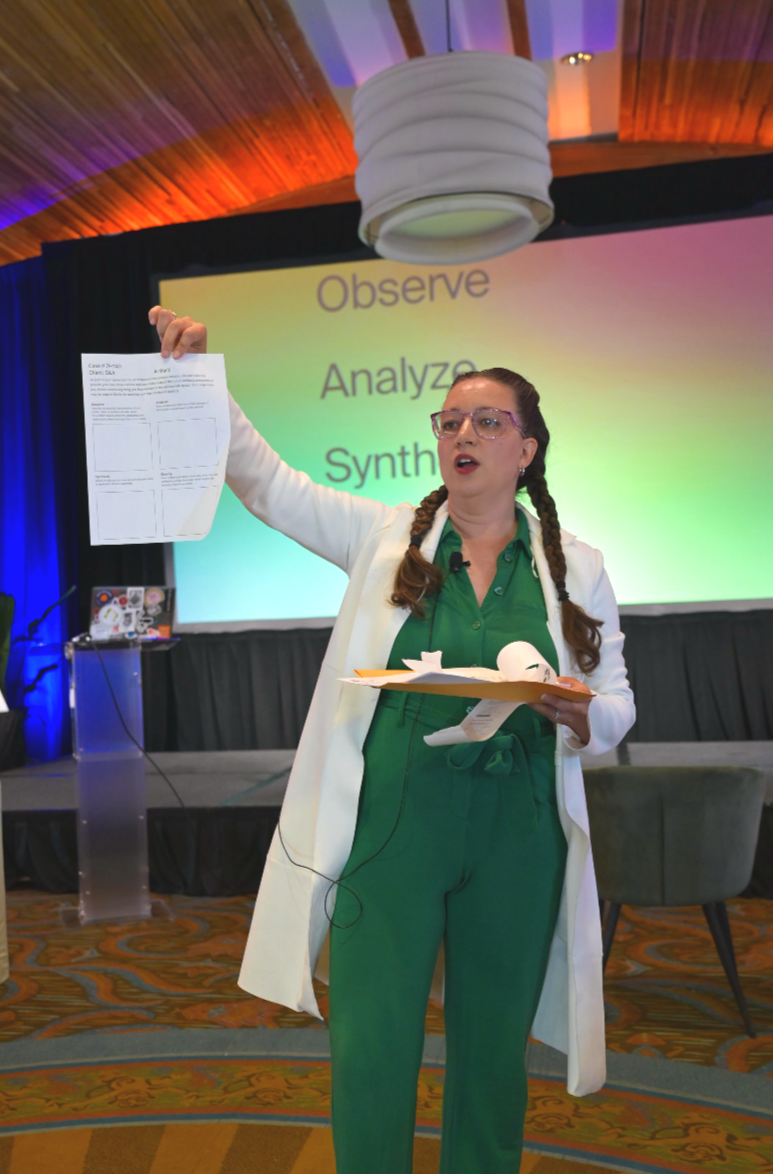
The (unofficial) doctor is in
Credit: Nelson P.
Offerings
Don't be afraid to be confused.
Try to remain permanently confused.
Anything is possible.
Stay open, forever, so open it hurts, and then open up some more,
until the day you die,
world without end, amen.
― George Saunders, The Braindead Megaphone
Talks & Keynotes
Provocative presentations that challenge assumptions and inspire action
Conference presentations often leave you inspired but unchanged—you return to your desk Monday morning with the same constraints you left with Friday. These talks aim for something different: giving audiences experiential tastes of futures methodologies they can immediately apply, not just information to file away.
-
The presentations balance provocation with accessibility. We draw on research showing how museums are already being reshaped by climate change, economic pressures, and decolonization efforts—not as abstract future threats but current operational realities many in the audience already navigate. Then we explore how futures thinking provides practical tools for responding to these forces.
Rather than just describing methodologies, the talks often include brief interactive elements where audiences practice futures thinking with design fiction and performative scenarios. These micro-experiences show how the work actually feels, demystifying approaches that might otherwise seem inaccessible.
The goal isn't leaving people with answers but equipping them with better questions to take back to their teams. What assumptions are embedded in our current practices? Which futures are we preparing for, consciously or not? How might we imagine differently together?
-
Prototyping futures for museums
Design fiction as organizational tool
Embracing uncertainty in cultural work
Museums as anticipatory infrastructure
Imagination as professional practice
How to museum in the future / how to future in museums
-
Conference keynotes
Panel participation
Webinars
Organizational presentations
Retreats and annual meetings
-
Introduction to futures methodologies that feel practical rather than theoretical
Permission to imagine radical alternatives alongside incremental improvements
Concrete examples of how other museums use futures thinking
Renewed energy for the possibility of institutional transformation
-
Museum Next Forecast Summit
Museums and the Computer Network
G&A Annual Retreat
Teaching Residencies
Integrate futures thinking into museum studies and design programs
Museum studies programs teach research methods, collection management, exhibition development—the mechanics of how museums currently work. But students graduate into a field undergoing fundamental transformation, often without methodologies for imagining institutions that don't exist yet.
The same is true for design as countless careers will emerge in the next decade.
These multi-week teaching residencies bring futures thinking into your museum studies or design program as legitimate scholarly practice, not just creative speculation. Students learn to treat "what if" as a research method alongside "what was" and "what is."
-
We work with faculty to develop curriculum that integrates futures methodologies into existing courses—not as an add-on elective but woven through the program. In exhibition design, students might prototype labels for post-climate museums. In collections management, they might explore stewardship practices for post-colonial institutions. The work combines academic rigor with speculative imagination.
Student projects push against current constraints: What would museums look like if admission was free and funded differently? How would interpretation change if exhibits were co-created with communities from conception? Students present these speculations using design fiction, scenario narratives, and prototypes that make imagined futures tangible for critique.
The pedagogy models holding critique and imagination in balance. Students analyze what's broken about current practice AND envision what transformed practice might become. They graduate not just understanding museums as they are, but capable of articulating and building museums as they could be.
-
Methodologies for imagining institutional alternatives
Capacity to articulate visions of transformation in compelling ways
Portfolio projects that demonstrate futures thinking alongside traditional skills
Confidence that their generation can reshape rather than just inherit current practices
-
You want students to graduate as change-makers not just job-seekers
You're open to integrating speculative methods into existing courses
You see futures literacy as essential capacity for the next generation of professionals
Prototyping Workshops
Build imaginative capacity through making possible futures tangible
Your team learns to work with uncertainty by creating—not just discussing—multiple futures. We use design fiction, speculative artifacts, scenario building, and experiential exercises to strengthen creative muscles and surface new possibilities.
-
Creating artifacts from the future (museum programs, visitor experiences, organizational structures that don't exist yet)
Card-based exercises and chance operations
Embodied and movement-based activities
Collaborative prototyping sessions
Reflection and synthesis
-
Museum staff at any level who want to think differently about their work
Teams facing major transitions or uncertainty
Organizations wanting to build futures thinking as organizational capacity
Groups ready to try unfamiliar approaches
-
Half-day intensives
Full-day workshops
Multi-day experiences
Conference workshops
Custom designs
Futures Literacy Training
Develop your team's capacity to navigate uncertainty and make better decisions
Your team knows how to analyze the past—that's what museum training teaches. But when it comes to planning, you're often stuck choosing between wishful thinking and worst-case scenarios. Neither helps you make decisions about programs to launch, partnerships to pursue, or infrastructure to invest in when you can't predict what next year will bring.
Futures literacy is the capacity to hold multiple possible tomorrows in your mind at once and use them as decision-making tools. Think of it like learning to read music—suddenly patterns become visible that were always there but you couldn't perceive. A futures-literate team can look at a community demographic shift and see not just threat or opportunity, but a spectrum of possible responses depending on which future unfolds.
-
This multi-session training program takes place over several months. We introduce practical methodologies: signal spotting (noticing early indicators of change before they're obvious), design fiction (making future possibilities tangible so you can test them), and scenario exploration (developing multiple plausible futures instead of one strategic plan). Between sessions, you practice these tools on real decisions your museum faces.
The goal isn't prediction—it's building reflexes for navigating uncertainty. After this training, your strategic planning meetings generate options you couldn't see before. Your team can evaluate a new program idea by asking "which futures does this prepare us for?" instead of "will this work?" You develop shared language for discussing change that goes beyond optimism and pessimism.
-
Identify emerging patterns in your community before they become crises
Generate multiple strategic options instead of feeling stuck with one path
Evaluate decisions through multiple future scenarios
Communicate about change without defaulting to either anxiety or denial
-
Your strategic planning feels reactive rather than generative
Your team wants to move past "this or that" thinking when facing complex decisions
You need practical tools for navigating uncertainty without pretending you can predict the future
Learning how to think really means learning how to exercise some control over how and what you think. It means being conscious and aware enough to choose what you pay attention to and to choose how you construct meaning from experience.
― David Foster Wallace
No Public Access
A 12-week learning cohort for prototyping the future of museums
A deep-dive program where participants develop futures literacy through weekly sessions, hands-on prototyping, peer learning, and guided reflection.
-
Bi-weekly 90-minute sessions
Curated pods for skill-sharing and encouragement
Introduction to futures thinking methods and tools
Museum 101: operations, governance, history, and practices
Experience design fundamentals
Hands-on prototyping and design fiction exercises
Peer learning and collective imagination building
Resources and frameworks to continue the practice
-
Individual practitioners wanting to develop futures thinking skills
People who want to push back on current encroachments by prototyping IRL
People who have a strong desire to do things differently in museums
People seeking community around museum futures
Those ready to commit to sustained learning and practice
Futures Consulting
Partner with your organization to prototype new possibilities
Working together over weeks or months, we prototype organizational futures, new program models, or strategic directions. Distinct from traditional strategic planning—we create tangible artifacts, test ideas, and build capacity while developing direction.
-
Design fictions of future programs or services
Prototyped experiences you can test with audiences
Speculative scenarios to stress-test decisions
Frameworks and tools your team can continue using
Facilitated sessions with staff, board, or stakeholders
-
Organizations in transition or facing uncertainty
Teams developing new programs or strategic directions
Museums reimagining their role or relationships
Leaders wanting to build futures thinking into operations
-
3-6 months
Mix of remote and in-person work
Custom designed to your context and questions
Museum Field Consulting
Get an insider's perspective when working with or building for museums
This service is for anyone working adjacent to museums who needs an insider's perspective: technology companies building tools for cultural institutions, designers creating for museum contexts, researchers studying the field, consultants developing museum-focused offerings, funders evaluating grant proposals, or organizations seeking museum partnerships.
-
Museums have unique constraints most outsiders don't see: governance structures where boards hold power but staff hold knowledge, mission-driven decisions that override market logic, audiences ranging from school groups to scholars, collections that legally can't be monetized, and institutional cultures shaped by decades (or centuries) of practice. Understanding these dynamics is the difference between a partnership that works and one that frustrates everyone involved.
-
We can provide the museum perspective you need—whether that's reviewing your pitch deck through a museum professional's eyes, identifying which institutions are good matches for your work, explaining why museums make decisions that seem irrational from a business standpoint, or helping you speak the field's language in ways that build trust rather than trigger skepticism.
This consulting works as single-session guidance, ongoing advisory relationships, or project-based support depending on your needs. You get clarity on how museums actually function, not how organizational charts say they should.
-
You're building something for museums but aren't sure how they'll receive it
You need to understand museum decision-making for your research or work
You want to partner with museums but keep hitting mysterious barriers
You're developing a product for museums, pitching a partnership, designing for cultural spaces, or researching the sector—but museums operate by their own logic