Seasonal Update Poster
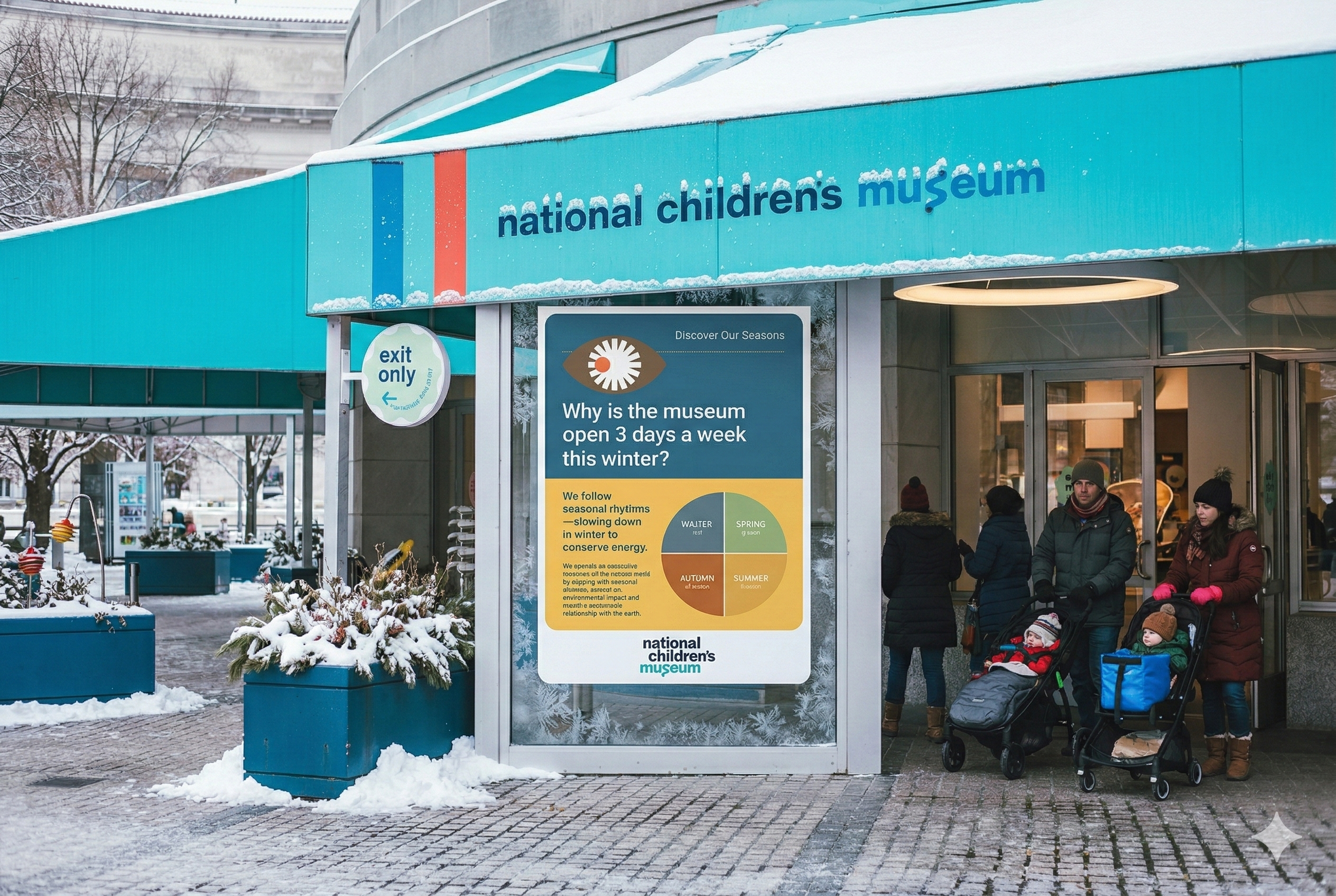
Outside the National Children's Museum on a January morning, a large sign stands next to the entrance doors. Families with strollers gather near the exit-only sign, their coats tightly wrapped, breath visible. A large question looms: Why is the museum open 3 days a week this winter? It captures the irritation of a visitor—half complaint, half demand—and the museum has displayed it prominently.
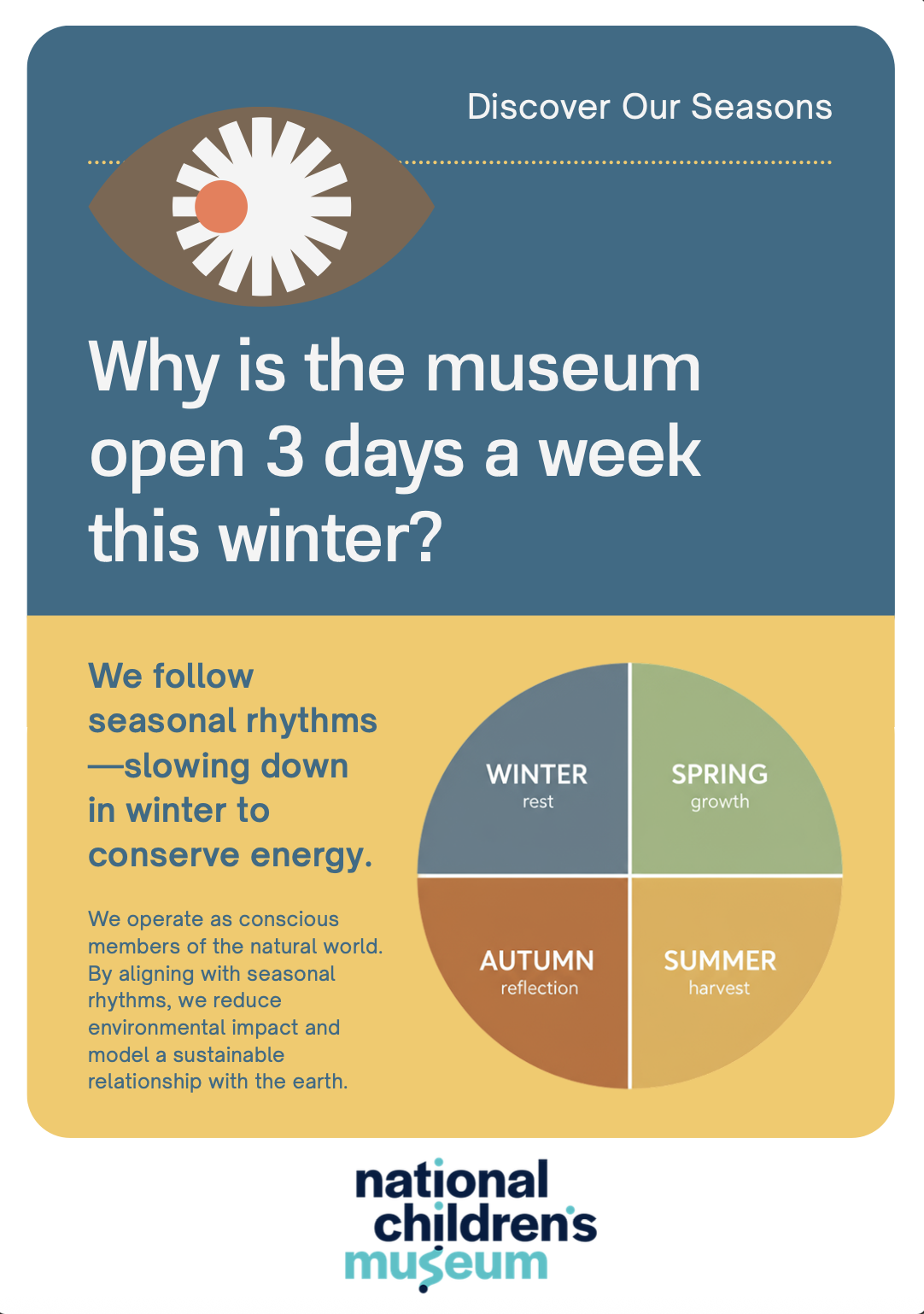
The answer follows in warm amber and teal: We follow seasonal rhythms, slowing down in winter to save energy. Beneath that, a simple quadrant diagram connects the four seasons to four modes. Winter: rest. Spring: growth. Summer: harvest. Autumn: reflection. Just four words set the stage for a different relationship with time.
The poster quickly stands firm. Typically, a complaint about limited access would prompt a longer schedule, more programming, or extended hours. However, the seasonal poster takes a different approach. It responds to the visitor's underlying frustration by referencing something larger than itself as its guiding principle, quietly shifting the museum from the center of its own narrative. We are not closed due to budget cuts or staffing shortages. We are resting because it is winter, and winter means rest. The museum has aligned its schedule with the earth’s rhythms and displayed that alignment clearly, within reach of anyone pushing a stroller through the door.
At its core, this is an argument about calendars and, ultimately, an argument about power. The Gregorian calendar—the one that dictates museum hours and school schedules, shaping most aspects of civic life today—is not a neutral measure of time. It is a technology that was created to serve specific interests: standardizing labor, enabling trade across different regions, and managing large populations. It has replaced a wide range of other ways people have organized time together through colonization, imposing administrative systems, and sheer institutional dominance.
Kalyani Tupkary's Calendar Collective acts as a living archive of those alternatives. It catalogs and publishes speculative calendars, drawing on voicemails and fragments to highlight the unique ways communities can structure time beyond uniform grids.
Her Even Odd calendar overlays an alternating work-and-leisure rhythm on the Gregorian structure. It invites participants to experience the tension between two systems, to feel physically what it means to arrange a day, a week, or a life differently. The world suggested by that calendar hints at a new social order, not just a new schedule.
The seasonal museum poster is quieter and more incremental.
It doesn’t replace the Gregorian calendar; it introduces a cycle over it, letting winter regain its meaning.
Yet, within this modesty lies its own argument: a shift doesn’t have to be complete to be genuine. An institution can start to reorient itself without waiting for a new social order to emerge. That this change takes place at a children’s museum is intentional. Children’s museums introduce kids to what institutions are—what they do, how they function, and what rhythms they present as normal. A child who visits a museum that slows down in winter and fully opens in summer learns about time that goes beyond the clock. They discover that the world has seasons, and those seasons carry meanings, that rest isn’t failure, and that an institution’s pace can be adjusted beyond maximum efficiency. They come to understand, through a simple Saturday visit with a stroller and a coat, that humans are not exempt from natural cycles, just temporarily shielded from them. This is a crucial lesson. It is, in fact, foundational to many other ideas.
Science centers have always included elements of this approach. Their programs track migrations, seasonal changes, and local species behavior. Botanical gardens close sections when plants lie dormant. Arboretums guide visitors based on the realities outside. However, history museums and art museums have mostly kept themselves away from this perspective, treating their collections as detached from ecological time and their buildings as sealed off from the natural world’s variability.
The seasonal poster asks why history museums do not engage this way. Why shouldn’t they, when their collections were created by people who lived through seasons, whose objects were made in particular climates, with specific weather, and in distinct relationships with the land? Why not art museums, where light conditions, visitor energy, and atmosphere shift with the seasons?
What design fiction achieves here is not a proposal for a transformed institution but a way to feel what such an institution could look like. It doesn’t suggest a policy or push for new laws. It operates as though the decision has already been made, as if the seasonal museum is simply the new norm. In this confident portrayal, the option of a museum that opens every day and treats all seasons as equal suddenly seems the less sensible choice.
Seasonal Poster is part of an ongoing series of design fictions examining how cultural institutions might change when they genuinely yield—to the collections, ecologies, and timeframes they claim to manage.Access the poster PDF here